
5 Ideas in 5 Minutes to Save Your Business 30-Percent
Quit your whining! It's time to start managing your business with facts instead of managing your business by assumption. Here's five ideas in five minutes to save you 30-percent.
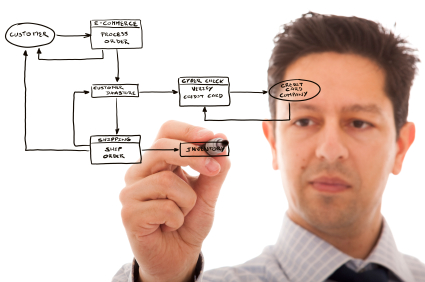
- Clock how long it takes an average customer to place an order with your company. Does the process take three minutes? Five? Ten? Twenty?
- Identify the average volume of orders you receive on a given day.
- Time how long it takes for the customer to contact you to the point the work order's actually in the fulfillment cycle. What is that time?
- Count the number of people that touch, read, authorize, or acknowledge the receipt of the order.
2. Transparency.
- How does the customer find out about the status of their order? Is it a phone call? How often per each order? How does that customer follow-up or get more information on their order?
- How does your internal sales team/employees follow-up on the status of an order? How frequently do they do such checks, and how much time does it take them? Fundamentally, how many people does it take to screw-in your light-bulbs?
- How difficult is it to see the progress of the order from your information system? Does the system contain 100-percent of everything you need to know as a manager, or just 30-percent? Do you find yourself walking-around trying to find the answer to questions about jobs that isn't answered by the information system?
- Are order statuses confirmed by shouting through the hall or by looking something up? Do you have to be in front of a computer at the office to look it up, or, can you look it up where-ever you might be?
- Do you measure your defect and scrap ratios? What are those ratios?
- How much of your service is corrective labor? How much of your business' time is thrown at corrective action or fixes to satisfy the customer?
- How frequently do get shipping, distribution, and transportation wrong?
- What's the percentage of your products and services that score exceedingly high on customer satisfaction? Aside from understanding what you're doing wrong, do you know what you're doing right?
- What's the total turn-around time and expense from order placement to delivery? Can you categorize both time an cost per product line or service? And thus, which products and services are the most and least efficient? The most and least profitable?
- What's the ratio of orders that deliver on-time with the desired features promised to the customer? How frequently are you breaking your promises?
- What's the number orders delayed, rescheduled, paused, waiting, or back-ordered? How do execution delays affect your cash flow position?
- How are suggestions from internal staff and your customers turned into policy and procedural changes at your workplace?
- Do you know most of these numbers and communicate them regularly to your staff?
- Does your company have a culture of learning from its mistakes and improving upon them, or, hiding mistakes and repeating them?
- How do you satisfy customers that you were slow in responding to, delivered a poor quality product, or disappointed upon delivery? Do you have a program for making customers happier?
- Each one of these things should be dashboard KPI's (Key Performance Indicators) that reflect the pulse of your business; that would reflect your management of the business. If you can't answer these questions, are you managing by facts or are you managing by assumption?
- If your computer system is incapable of yielding some of this data or is yielding inaccurate information, why are you relying upon it?
- If your computer system isn't automating a majority of these processes and enabling better transparency, faster and more accurate and more reliable business processes, and enabling your team to satisfy customers ... why own a computer system?
- If you or your staff aren't constantly learning from mistakes and missed opportunities, then you're likely repeating the same problems and creating a culture around mediocrity. Without metrics and practices like these, how is anybody in your organization held accountable - the least of which would be you.
- Some of these best practices could literally re-shape the relationship you have with customers and staff; if you're not building internal and external relationships to foster trust and community, you're constantly driving a wedge between efficiency and client retention.
5 New Economy IT Strategies
How's your small business going to cope in the new economy? Here's 5 New Economy IT Strategies that's a must-read for any small business owner.
Hey, how're you doin'?
Nice to meet you.
Say, if you're a small business owner and if you and I were to connect for the first time on the street, here are the kinds of problems I'd guess you're having.
Just bear with me for a minute.
- Rising energy costs. You're watching the events happening in the middle east and may feel a bit uncomfortable about oil and gas prices. And as the economy heats up, there's going to be even greater demand on scarce fuels, further driving the price up. Experts are talking about $5-gallon-gas next year. You're concerned and you want to be prepared for it.
- Mobile. Your workforce (if not your customer base) is mobile and wants greater access to information systems using phones, tablets, and from home. You want to accommodate but you're not sure where to start. You're not even sure if your stuff can be used or seen on mobile devices.
- Mixed Messages. Your team's probably tired of juggling cell and company voicemail, email, and instant messaging across many mediums and platforms. Diversity in communication might be up but effectiveness might be down - the right message ain't reaching the right people at the right time.
- Social. You've caught up with social media fad but you're not certain what it's doing for you, or, how it's extending value to your customer relationship. How is this Social-stuff translating into favorable behavior or more work anyway?
- Acquisition costs. Obtaining more capability is expensive. There's an inherent barrier-to-entry with a lot of this new IT stuff. It' not like this economy has made you flush with cash to spend frivolously. You need proven solutions without guesswork.
Wow. That's hitting the proverbial nail on the head.
Now, we'd chit-chat about these issues and I'd eventually come around to showing you 5 new economy IT strategies to address each of these concerns.
.
[adsense format="wide"]
.
1. Cloud Computing. If you still own a server the server forces your team to be sitting next to it to access information. You're absorbing and paying for the risk in managing that asset. Own nothing. Own a server? Ditch it! Own a phone system? Why? Buy software? Seriously? Lease capability from vendors and shift your risks to them. Replace your expensive hardware with inexpensive appliances that access web-based resources. Instead of paying for tech services you have to manage and pay for yourself, you'd be using a utility - it's time to think of your technology like water, electricity, or plumbing: it's a service you use and not an asset you maintain. Cloud licensing is subscription-based so you only pay for what you use - lowering that barrier-to-entry for immediate capability.
2. Telecommuting. It's time to sit down and honestly talk with your team about this. The bandwidth's there, the infrastructure's there, the Cloud is there, now it's just a management decision. Why pay anybody to drive 30+ miles for the privilege to type in your building? Can't offer your team raises or other benefits? Give them the benefit of self-direction and time management, and, the ability to lower their own energy costs by driving less often.
3. Integrated Communications with Relationship Management. Your land-line, toll, cell, voicemail, email, instant messaging, copies, fax, and social interactions can come under one software, one view, one channel. The capability's there - you just need to implement. What that creates is a single inbox for your players where there's no distinction of medium. Further, all of this content can be married with CRM (Customer Relationship Management) systems built in to that inbox. Why have your team running around with their heads cut off wondering where something is? Give them the gift of a single virtual inbox.
.

.
4. Shrinkwrap. This is a term I like to use for corporate downsizing in a cool, necessary, and strategic way. You see, with more efficiency, more Cloud, more Telecommuting, you can stop paying those outrageous property taxes you've been complaining about; you don't need to renew that lease; you can rent office rooms when you actually need them; you can shrink the corporate presence to a smaller - and more economical - footprint. Why pay for a facility that's mostly empty? Here's your chance to make structured, strategic changes to your fixed expenses: get smaller. Become more agile. Think faster than you're competitor who're stuck with buildings, skyscrapers, and other structured/expensive costs they can't get out of.
5. Extend Value. Social media gives you a way to connect with your customers in amazing ways. Now's the time to see how technology can not just automate your workforce but empower your customer to do business with you - how are you making it easier to contact, work-with, and use your product/service? How're you using Social to listen and respond to your customer? Hey - heads up: you're a media company now! "Hi, Channel 5: what's up?" How're you building and cultivating your audience. How can you use social to attract attention?
Now's the time to get curious as a business owner: what's possible under the budget constraints you have? Can you implement two or maybe three of these strategies to prepare for the new economy? Maybe all five? Whatever. Now's the time to start asking questions. What you don't want to be is just like everybody else, scrambling for options when there's no more time to implement.
That's right: money for nothing and chics for free.
Thanks for reading.
R
5 Small Business Predictions for 2011
What should small businesses be prepared for in 2011? Let the Oracle of Vancouver explain it to you!

Okay, every year I've offered some insight into the year ahead for small businesses. In fact, I think it's quite common for any consultant and would-be psychic to demonstrate their astute prowess and outline clear bets. And this year is no different!
So - in a very envelope-to-forehead moment - here I go: my five predictions for the small business in 2011.
1. Lean. Call me a nattering naybob but I'm still not convinced that postponing tax breaks is going to eliminate uncertainty, nor is sustaining the current level of taxation going to put more money in people's pockets. I mean, it hasn't already so...? Economists are forecasting flat employment growth throughout 2011. So I think the small business is going to stay lean. They might even get leaner, employing some of the trends and tech below to reach even higher economies of scale and automation. Small businesses are learning - must learn - to do more with less, consistently, to survive. Look for some small businesses to fold whereas others take more drastic steps to achieve profitability: fire bad customers, lay-off entire regions or divisions, or, eliminate the need for a building.
2. Cloud. Why own when you can rent? That's really the idea being tossed around in the housing market but it's also applicable to small business computing! Why own a server, or, an application, when you can rent it for a period of time? And when you don't need it any more, ditch it? Efforts by all of the major vendors is making the cloud easier to reach and use by everyone. More small businesses will adopt cloud-based technologies and abandon the use of local servers. Look for more small businesses raising their hand and asking about the maturity of some of this technology, and for developing a migration strategy.
3. Social. If mass media is too expensive and budgets are tight, it doesn't take a rocket scientist to believe small businesses will start looking at social media as a viable alternative. Social networks allow businesses to get closer to consumers than ever before and to personify their brand. Yeah, we're going to see more of that. Look for small businesses to out-pace enterprise adoption, and to apply this technology more creatively, winning-over tight-wad consumers and convincing them to spend their scarce dollars locally! You just watch ... look for a substantial shift in marketing expenses away from television, radio, and print as traditional media continues to writhe and die a horrible, prolonged death.
4. Mobile. Next year will bring a gaggle of new gadget tech. The new iPhone 5 that'll feature 4G; a new iPad 2; a bunch of Android competitors; more eBook readers. Personally, I don't know where consumers are going to find the funds to invest in all of these disposable toys but, hey, the demand seems to be there. Look for small businesses to start leveraging Cloud and Social strategies across Mobile platforms to offer themselves greater flexibility in staffing and building expenses. Watch for people who passed on the iPhone 4 to scoop up the iPhone 5, and Apple - whose being fiercely eaten alive by Android in terms of market share, will announce some really cool features and enticements to retain their customer-base and pull-in defectors from the Android camp.
5. eBooks. Everybody's getting into them. Amazon, Google, Apple. This whole decade will be about transforming the distribution channel for books and video into an electronic medium, just like last decade was about music. Everybody, including you, are changing your consumer preferences! Self-publishing is here. Also, self-service is here because of plentiful low-cost bandwidth. Look for downward pressure on growth for large chain booksellers and video outlets; look for small/niche/specialty sellers in local communities cropping up to take their place. Look for our consumer habits to shift with more people consuming digital media over paper.
Predictions? Or perhaps I've just a command of the obvious? Meh, you decide.
By the way, I really liked this article from the Business Insider articulating 10 ways every small business should be preparing for 2011. Really good read!
R