

Compliance and Security: Why Vancouver Financial Advisors Need Local Expertise
For a financial advisor, trust is everything—but AI-driven cyber threats are changing the game. Standard, out-of-state IT support can't keep up with shifting regulations or localized risks. Discover why Vancouver firms need a local IT partner to fortify defenses, protect client data, and guarantee total regulatory compliance.
It’s All About Trust
As a financial advisor, your business is built entirely on trust. Clients hand over their life savings, sensitive tax documents, and deeply personal data because they believe you can protect it.
However, meeting IT compliance standards expressed in state cybersecurity and privacy laws or GLBA is no longer just a matter of checking boxes or filling out paperwork.
In today’s hyper-accelerated threat landscape powered by AI aggressors, understanding your vulnerability is about raw survival.
What’s Happening
The reality of cybersecurity has shifted dramatically. Cybercriminals are no longer just individuals typing away in dark rooms. Organized teams (if not state actors) are utilizing sophisticated LLMs to mount dozens if not hundreds of attacks in real time.
These AI-driven actors can scan your networks for vulnerabilities 24/7, craft highly convincing phishing emails in seconds, and launch rapid attacks that outpace traditional software defenses. Cybercrime, it turns out, is a profitable $1.5 trillion-dollar business.
Ignoring your IT infrastructure under these conditions carries catastrophic risks:
Devastating Fines: Regulatory bodies are aggressively penalizing data oversight errors.
Irreparable Reputation Damage: Trust takes decades to build but disappears after a single data breach notification.
Total Operational Paralysis: An unexpected ransomware attack can lock you out of your client management systems for days.
Get To Know Somebody Local
This is where local expertise becomes your secret weapon. A cookie-cutter, out-of-state IT helpdesk cannot physically walk into your office to audit your hardware, nor do they understand the specific local regulatory nuances affecting Pacific Northwest firms. A local IT partner ensures your systems are fortified against modern AI threats, your data backups are bulletproof, and your operations remain fully compliant.
Don't wait for a digital audit or a breach to discover your vulnerabilities. Protect your clients, safeguard your reputation, and secure your practice by keeping your IT expertise close to home.
Need help? We’re right here in Clark County, Washington. Drop us a line.
R
The Competitive Edge: Why Vancouver, WA Financial Firms Must Educate Employees About AI
Is your small business prepared for AI-powered fraud? Artificial intelligence has revolutionized cybercrime, allowing bad actors to launch hyper-personalized social engineering scams at an unprecedented scale. Discover how advanced tactics like voice cloning and flawless phishing lures threaten your company, and learn the proactive verification protocols needed to protect your assets.
As a small business owner, you are likely already stretched thin managing operations, cash flow, and staffing. It is easy to view cybersecurity as a static checklist.
However, the rapid rise of consumer-facing artificial intelligence has fundamentally changed the digital threat landscape, and staying on top of these evolving AI threats is no longer optional.
The Threat of AI
Yesterday’s cyber scams were often easy to spot. They were plagued by poor grammar, awkward phrasing, and generic greetings. Today, bad actors are leveraging advanced generative AI tools to execute highly sophisticated, hyper-personalized attacks at an unprecedented scale.
For financial firms, AI-driven cyber threats pose a profound risk because they target the industry's most valuable asset: absolute trust. Modern fraudsters leverage advanced generative AI tools to execute hyper-personalized social engineering attacks at an unprecedented scale, easily bypassing traditional technical defenses.
By using AI to scrape public data and professional networks, attackers can instantly draft flawless, authoritative phishing emails that perfectly mimic regulatory bodies, institutional banks, or established vendors.
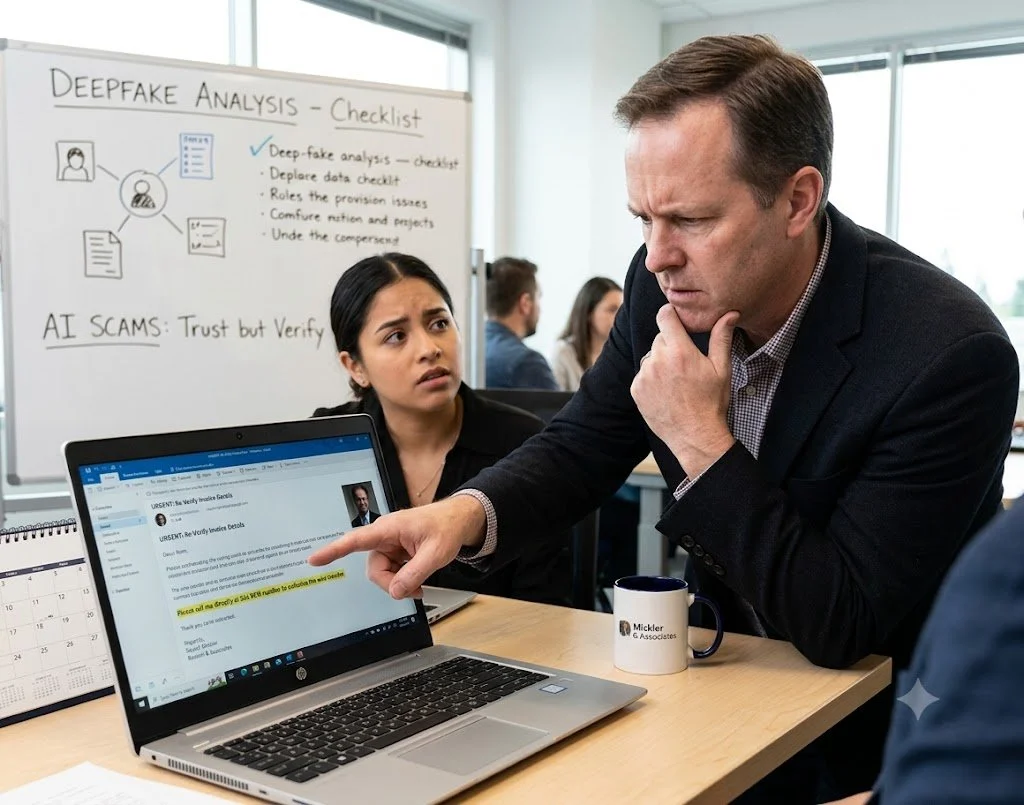
Furthermore, the advent of sophisticated voice cloning (deepfakes) allows criminals to replicate the exact voice of a firm's executive or high-value client over a phone call, creating high-pressure scenarios designed to authorize fraudulent wire transfers or bypass strict compliance protocols. In a sector where security and data integrity are paramount, these evolving AI scams turn human psychology into a direct gateway for catastrophic financial and reputational loss.
Let’s Review How AI Has Upgraded the Fraudster's Toolkit
AI-driven social engineering bypasses traditional technical defenses by targeting human psychology with unsettling precision. Management must train teams to look out for these advanced tactics:
Impeccable Phishing Lures: AI tools allow hackers to instantly draft flawless, authoritative emails that perfectly mimic the tone, vocabulary, and formatting of legitimate vendors, banks, or local utilities.
Hyper-Targeted "Spear Phishing": Attackers use AI to scrape public data and social media profiles, automatically crafting customized messages that reference real projects, timelines, or mutual connections.
Voice Cloning (Deepfakes): Using just a brief audio clip from a public video or voicemail, AI can replicate a business owner's or vendor's voice. Scammers use these clones over the phone to authorize urgent, fraudulent wire transfers or bypass security protocols.
Remedy Begins with Education
Defending your business against AI-powered threats requires proactive management. You cannot rely on employees simply spotting typos anymore. Safeguard your company by implementing strict verification protocols — such as a mandatory secondary phone call to a trusted number before transferring funds — and fostering a culture where security is regularly discussed. Dictate security from the top, because in the age of AI, an uneducated team is your greatest liability.
Need help? Ask me a question.
R
Your Employees Take IT Cues from Leadership: Setting Security Expectations from the Top
Is your small business secure, or is convenience creating a vulnerability? Cybersecurity is more than firewalls—it is a cultural reflection of leadership. When management bypasses safety protocols, employees do too. Discover how to set a secure tone from the top, implement clear policies, and protect your business by leading by example
When small business owners talk about cybersecurity, they usually focus on firewalls, software updates, 2FA, and encryption.
While those technical tools are necessary, they are completely useless if your organizational culture undermines them. In the world of small business, cybersecurity isn't just an IT problem, it is a cultural reflection of management’s priorities.
Employees watch leadership closely. If owners and managers treat cybersecurity protocols as optional nuisances, the rest of the team will follow suit.
The Trickle-Down Effect of Lax Security
If you bypass multi-factor authentication (MFA) because it takes too long, share passwords via sticky notes, or repeatedly delay critical system updates, you are sending a clear message to your staff: security doesn't actually matter here. Sigh. If I had a nickle…
When leadership exhibits lax behavior, employees naturally mirror those habits. They begin reusing passwords across platforms, downloading unapproved applications, and ignoring phishing warning signs. No amount of expensive software can protect a company when its own team actively bypasses safeguards due to a culture of convenience.
How Management Sets the Tone
Fostering a secure business environment requires active leadership. You can establish a robust security culture by prioritizing three foundational steps:
Implement an Acceptable Use Policy (AUP): Clearly define written expectations regarding how company technology, data, and networks must be handled.
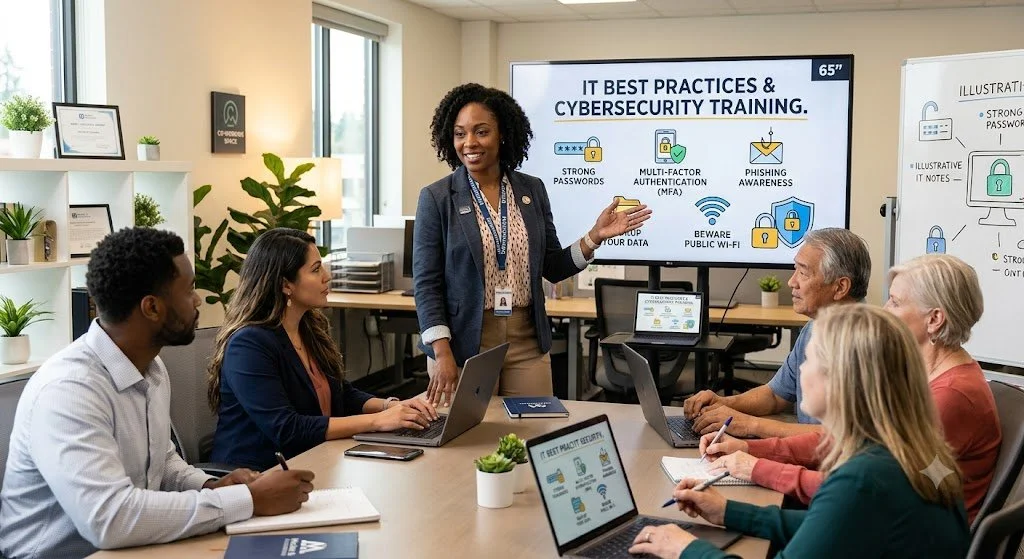
Provide Ongoing Training: Move away from "one-and-done" onboarding. Regular, engaging security awareness training keeps threats top-of-mind for your team.
Lead by Example: Model the behavior you expect. Follow every protocol, use a password manager, and openly discuss security priorities.
Only You Can Model Best Behavior
Ultimately, your team will only take technology safeguards as seriously as you do. By actively prioritizing IT best practices, you transform cybersecurity from a technical chore into a shared organizational value.
R