
How Small Businesses Will Survive COVID-19
Small businesses have the ability to create experiences that larger companies can’t replicate. It’s those experiences, those expressions of genuine human kindness, that will differentiate your value and keep your customers coming back … even in the most difficult of times.
It’s undeniable that small businesses face unprecedented challenges in the age of COVID. These are difficult times for everybody and - arguably - the difficulties are just beginning.
Still, regardless if it were a hurricane, a major earthquake, a financial crisis, or a pandemic, it’s my view that small businesses have a competitive advantage during tough times that much larger firms do not.
I’m not referring to their smaller size, their nimbleness, or their innate ability to quickly shed fixed costs. Rather, small businesses have a face. Your face.
Your small business has the ability to project sincerity and compassion in a way that larger firms cannot. Your competitive advantage as a small businesses in hard times is kindness.
People. And I’m talking about customers, vendors, employees, and service providers. Even in an extremely disconnected, automated, and disintermediated economy such as ours, in a practical sense, businesses cannot operate without people buying, selling, delivering, shopping, providing, shoveling, mopping, cleaning, browsing, clicking, or calling. People drive every aspect of our business.
In times like these, savvy small business owners would do well to recognize their unique ability to connect with people as an advantage in every transaction. That they have the opportunity to project sincerity and compassion in ways a bigger company cannot.
And that could come in so many forms. More smiles. More listening. Arriving on time and respecting somebody’s time. By not taking a single opportunity for granted. Through offering a simple sticky note to affirm somebody’s great work. By being enthusiastic. By focusing on the good around us rather than chronically dwelling on the bad. And sure, more tangible things like more bonuses, more breaks, more time off, more leeway, more investment in PPE, or more flexibility - understanding that schedules aren’t as reliable as they had been - but the real advantage being exercised here is just human kindness.
Think about the last COVID-19 response you received from your big bank. It was delivered at four in the morning. It said (with a charming, smiling clip-art graphic), “We’re here for you day and night!”, and it offered a link to their website so they could continue to take your money for credit card or loan payments. They’re a huge corporation! They can’t honestly identify with you insomuch as you can relate to them. Inasmuch, your big bank can’t possibly appear sincere, or empathetic, or truly engaged.
Now picture somebody like me, a computer consultant, coming in to your place of work. I arrive on time. I’m dressed professionally. Sure, I smile under my mask these days, but people can see that in my eyes. I engage in friendly conversation, empathize with your current situation, and I quickly resolve the technical matter. I explain what went wrong in easy terms you can understand. Further, I explain strategies for how we might avoid it in the future. I leave you my business card so you can contact me at any time. And I thank you once again for your continued business.
Now, that’s all just something the big tech support firms, the big box stores, and the nameless phone companies can’t do. They’ve focused so much of their business on scale, volume, you’re a number so be a number, take a ticket, leave a message, press a button, wait a day, but please keep having problems, and pay our retainer, keep feeding us money to support our waterfront offices … sigh.
Well, which of those experiences are you going to remember?
Kindness is competitive.
I feel that demonstrating genuine, compassion to others is the value-add that the big guys simply can’t compete with. In good times or in bad. It could be the advantage that inspires your team to keep coming back to work. It could be the gentle reminder of a pleasant experience that brings a customer back. It could be the portrayal of confident professional enthusiasm that’ll prioritize a check for you in the mail this week.
It could be that kindness … is the one thing that makes you, your products, your services, more memorable, and keeps people calling you over somebody else.
G-Suite End-Users Hardened Against Phishing Attacks with BIMI
Google is implementing the BIMI standard to help protect G-Suite users from spam and fraud, and to help filter phishing attacks.
Phishing attacks are emails that attempt to trick the user to click on a hyperlink to access a system they shouldn’t. In order to convince the user to click, hackers will often include the business logos of trusted brands to bestow a feeling of legitimacy and importance.
On July 21, 2020, Google announced a new security feature that’ll be rolled-out to G-Suite users to help protect them from these kinds of attacks.
The feature implements an emergent email standard called Brand Indicators for Message Identification (BIMI) and its function is to uniquely verify the use of corporate logos using the DMARC system - the same system that’s used to validate the authenticity of an email sender.
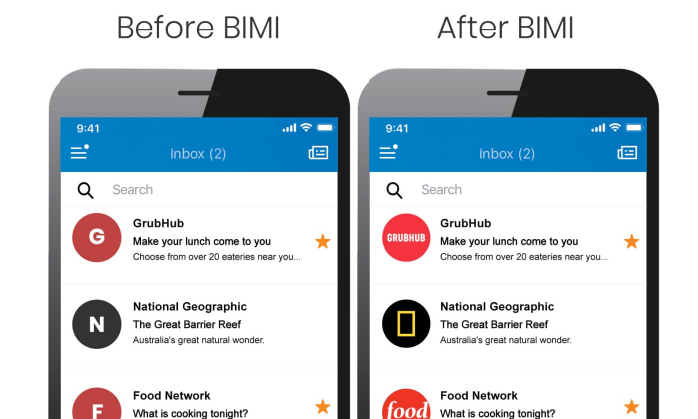
Emails delivered to Google’s mail system are scanned for fraud and abuse. Under BIMI, a registered brand logo will be validated and presented to the G-Suite end user in the round avatar slot aside an email. It’s a visual cue that both re-affirms brand-trust and indicates safety to the end user.

Messages that fail validation for the use of a corporate logo are filtered from the end user.
The technical side of BIMI requires email senders to:
use SPF and DKIM, and to publish a specific DMARK enforcement policy for the domain of either “p=quarantine” or “p=reject”.
register their logo with the BIMI working group and publish a BIMI record;
acquire a Verified Mark Certificate for their logo (a Google-specific requirement currently offered by only Entrust, DataCard, and DigiCert).
All of these controls benefit the G-Suite user as fraudulent use of corporate logos would potentially be filtered, making their use within spam and phishing attacks useless.
Google intends to implement this feature (and many others related to mail safety) over the next year.
Microsoft is the Problem, Not the Solution
Microsoft has a proven track record of failure: updates prone to harm systems, vulnerabilities that allow ransomware to exist, unacceptable online compromises and downtime … nobody can trust Microsoft products in their small business.
On Wednesday July 15, 2020 - across the world - millions of Microsoft customers went to open Outlook and it crashed. Completely. Users couldn’t access their email using their Windows computer at all - not unless they bypassed Outlook and went online to use a web-based version of Outlook.
Microsoft eventually posted a server-side fix for the issue, rolling it out around noon PST. This is to say that millions of people - on tax day in the United States, no less - lost nearly a day’s worth of productivity.
And Microsoft just shrugged.
In February 2020, Microsoft released security updates that deleted the private data of Windows users. This came on the heels of over four years of disruptive updates that spoiled industry confidence and forced Microsoft to try and explain themselves; even an ex-Microsoft employee described the quality control problems at Microsoft as being systemic.
And Microsoft just shrugged.
So how about - in January 2019 - when Microsoft Office365 was down for two whole days?
Yeah, Microsoft just shrugged.
Meanwhile, Microsoft’s Office 365 security is equally questionable. In 2020 alone, to date:
January 2020. Hackers use malicious apps to gain access to Office 365.
April 2020. An alert from US-CERT describing the vulnerability of millions of MsO365 users; more than one million compromised accounts per month.
May 2020. A hacking threat to Microsoft Teams was announced, threatening another 75 million users.
Microsoft just shrugged.
And finally, ransomware is a significant issue: attacks by aggressors who extort users by encrypting their data. Yet, Microsoft’s mediocre quality control is responsible for the most prominent malware of 2018-2020:
Cryptolocker. It exploits a vulnerability in the Windows platform.
Wannacry. It exploits a vulnerability in the Windows platform.
Cryptowall. It exploits a vulnerability in the Windows platform.
Locky. It exploits a vulnerability in Microsoft Word.
Petya. It exploits the file system of Windows.
Microsoft just shrugs.
One could ascertain that the problem is that Microsoft doesn’t give a hoot about its customers.
Others might suggest that Microsoft looks at systemic vulnerabilities as a marketing opportunity to convince users to upgrade or replace their computer systems.
Yet others could criticize Microsoft’s shoddy quality control.
Whatever the reason, Microsoft is chiefly responsible for the lack of security, quality, and confidence in their products and services.
It’s Microsoft’s inattention to these matters that put small businesses and their data at risk. Our computing platforms should be ever more resilient, more reliable, and more secure - every year - but Microsoft’s solutions prove the inverse.
It is my opinion that it would behoove any small business to seriously consider in what ways they could minimize the use of Microsoft’s products within their control.
And here’s the great news: there’s a ton of other options for small business that doesn’t involve Microsoft solutions. Ask me how.
Related Links:
2021.03.17. Microsoft Releases Emergency Patches to Allow Users to Print.
2021.03.06. Exchange Server Hack Morphs Into a Global Crisis.
2021.01.14. A Single Icon on your Desktop Can Corrupt Win10’s File System.
2020.12.24. Hackers Accessed Microsoft Cloud Customers Info Through 3rd Party.
2020.12.17. Microsoft 365 Was Hacked; The Government was Compromised.
2020.12.11. New Malware Can Infect 30,000 Windows Machines a Day.
2020.10.21. Windows 10 emergency update: US government just issued warning
2020.10.19. Disastrous Windows 10 update is reportedly breaking some PCs
2020.09.23. Windows Updates Appear to be Broken Again
2020.09.19. Homeland Security Urges Immediate Patching Against ZeroLogon Exploit.
2020.09.17. Microsoft 360 MFA is insecure and has been for years; fix coming in April 2021.
2020.09.05. .NET Used by Malware to Create Excel Docs That Bypass Security Checks.
2020.09.02. Windows Defender Can Be Used to Download Malware.
2020.09.01. New Windows 10 Update Could Leave Users Without an Internet Connection.
2020.08.30. Microsoft Leaves a Windows 10 Active Security Exploit Unfixed for 2 Years.
2020.08.27. Windows 10 Could Kill your SSD.
2020.08.20. Microsoft Makes it Harder to Disable Native AV Software.
2020.08.11. Windows 10 Error is Playing Havoc with User Passwords.
2020.08.07. A Old Microsoft Word Doc and a Zip File Can Hijack a Mac.
2020.08.02. Microsoft Edge is Malware.
2020.07.25. Hackers seizing on trust placed in popular Microsoft Office software.
2020.07.27. Opening and closing your laptop could be enough to crash Windows 10.
2013.07.11. Microsoft collaborated with NSA to allow access to email servers without warrant.