
Useless Technology Investments Yield No Value
Here's an example of how completely useless technology investments yield absolutely zero value.
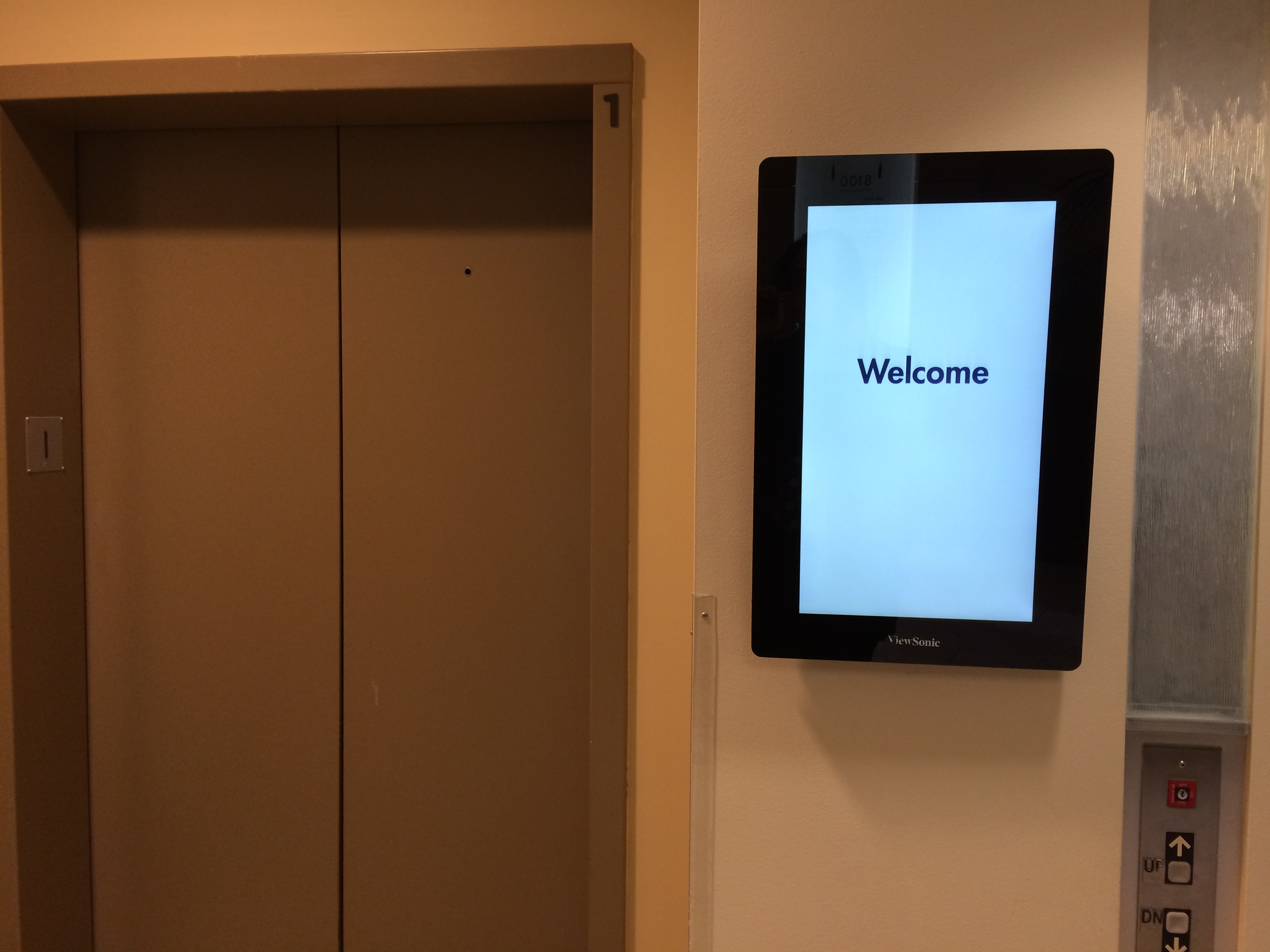
This is a monitor mounted on the wall in an elevator lobby in Vancouver, Washington.
It's actually representative of nine other similar monitors installed across five floors and two buildings on the same property.
Each and every monitor displays just one word. Welcome. And it's displayed welcome for well over four months.
It's so freekin' awesome. Serious. The graphic never changes. They all just display welcome and the word is now pretty much burned into the monitors.
So, I'm trying to think of the costs associated with this overly-expensive welcome sign. The electrical wiring, the network wiring, the labor, the capital equipment charges, the logic/service that must tell the screen to display welcome. I mean, all told, we must be talking some tens of thousands of dollars spent on the project to permanently display welcome on every floor.
Lost. Wasted. Trashed. Flushed. Worthless.
Remember how I was just talking about how technology should provide value? How does this provide value? Better, let's use our imagination and think about how it could provide value:
- The monitor could display a building directory of tenants.
- It could display a cheerful video describing the benefits of becoming a tenant.
- It could be an interactive tool to help guide people to their desired tenant.
- The monitor could highlight a tenant every month, extending appreciation for tenants.
- Why, the monitor could even display a calendar of events important to the property manager.
- It could inform tenants of upcoming maintenance activities, like, for example, getting the electronic directory system working.
- It could display a blog from a snarky technology consultant criticizing the strategic value of an electronic welcome sign.
Just think of the possibilities! Meanwhile, this thing just sits there displaying the same graphic every day, extending no value than what couldn't have been provided by a 1 meter stick, cardboard paper, a thick Sharpie, and some glue. Essentially, this investment is worthless and yields no value. Why do it? Why invest in it? Why spend all that money and time and resources to just ... welcome people?
What's the value in technology spending if it just does stuff like this? What's the strategy? How does it reduce expenses, contain expenses, or generate revenue? How does it differentiate this property from other similar properties? How does it speak to the property management's values or express value or appreciation in every tenant relationship? What's its purpose?!
Anyway, this stuff yanks my chain. If you've got any example of totally worthless tech, I'd love to hear about it. Snap a picture and send it to me on Facebook. Thanks!
R
Providing Value
What is your small businesses' value proposition? How does technology work to extend value to every customer in every transaction?
What's Your Value Proposition?

When it comes to differentiating your small business from other competitors, t's all about value. Some might call it your value proposition. Value is what is intrinsic to your customer relationship. It's what you promise, what you'll deliver and what the consumer will receive, by doing business with you. What do they get with your business that they can't get any place else?
You've got to be a little smug here. This isn't the time for thinking about conformity, mediocrity, getting along, fitting in; you're not like everyone else! If you are, your value proposition is ambiguous and unclear - all you're competing on is price, and that's a one-way trip to the bottom of the opportunity barrel. So you've got to think differently. There's nothing wrong with accentuating and articulating the differences you provide over your competitors. The more you clearly understand that, the more you can leverage it. Know thyself, right?
Thinking Differently in a World of Change
Don't be shy. Be bold! Be critical! As a business owner, you must constantly think about what value you bring over somebody else, and how you're leveraging your core competencies, values, and differentiation strategies to extend something really different to the consumer. Your competitors are always changing; you've got to be on your toes and changing, too. Nothing is stagnant. Products change. Consumer expectations change. Competitors change. Business models change. Delivery models change. And they're changing more rapidly than ever.
The other day, I was visiting a supermarket with a small satellite bank branch within it. I was standing in line and met with a teller who used to work at a full branch up the road until it closed. I explained that I endured the line today only because I'd reached my electronic deposit limitations on my cell phone; I had to deposit the checks physically because I'd exceeded a daily electronic limit. She lamented, "Yeah, soon, we won't have a job," recognizing - rightly - that change has rapidly altered the value proposition for her company:
- Even the satellite bank branch in the supermarket was inconvenient to the consumer as compared to doing electronic banking across their mobile device;
- Inconvenience translates into customer frustration, changing the value proposition for the bank - they don't want their brand to be known for lines and frustration;
- Eventually it will become too expensive to staff, lease space, and compete in the physical world as compared to offering electronic banking;
- Consumers increasingly deal with numbers on a screen - not physical checks or currency. Technology has transformed the banking experience and thus the value proposition offered by the bank and its competitors. Among other things, that means the future for a bank teller - let alone physical bank branches - is probably quite bleak.
Applying the Lens of Technology Strategy
So how does your small business create value?
- Experience. How does the experience differ from your competitors. How is technology enabling or disabling that experience?
- Access to Expertise. How can technology quickly connect the right expert from your organization to the customer every time?
- Quality of Products and Services. How can the use of technology assure the customer of a consistent, painless, quality product/service?
- Attention to Detail. Can technology be used in your organization to cross every "T" and dot every "I"? How can it be used to avoid mistakes?
- Customer Appreciation. Technology can be employed to extend gratitude towards the customer and thank them for their continued patronage?
- Personal Connection. Can technology help extend personal, intimate value to your customers? Even in the absence of a person make the experience more personable, customized, targeted?
- Time in Response / Time to Deliver. Is there a way that technology can improve the amount of time it takes your company to respond to clients, or, deliver your products or services? Can can immediacy become as much a part of your value proposition as quality service?
How does your small business capture value?
- Feedback. Can technology be used to capture the customer experience in the forms of electronic surveys? Can the customer experience be always measured - like a heartbeat - and managed?
- Participation in Social Media. How is your company listening to what your customers want, and, asking them for more input on what you're doing well, or, need to improve on? How is your firm sharing knowledge, expertise, and quality experiences with others?
- Experience Capture. How are internal systems engineered to routinely capture customer experiences so they can be measured?
- Systems Analysis and Corrective Action. How does your business incorporate what it's learned from listening (social media), from feedback (surveys), and empirical data captured by its business processes to change their value proposition? To alter their business practices to meet consumer expectation?
How does your small business deliver value?
- Ease of Use. Does technology make it easy to do business with your company? Is it easier to do business with you or your competitors?
- Extended Value. Does every transaction yield more information? Zoomcare is a great example. Your electronic medical profile is available at all Zoomcare locations, and when you want it, you can have a copy of your electronic medical record (even pictures and x-rays) burned to a CD ROM right there in just a few minutes. Every time you go to Zoomcare, you're getting extra and extended value out of the engagement.
- Speed and Rapidity. How quickly can you get your work done? How quickly can you meet the customer need? How quickly can you meet or exceed expectations?
- Personalization. Is every experience tailored to meet or exceed the customer's preferences?
Now's the time to start thinking about the value your firm provides.
R

Building Brand Equity as a Small Business Tech Strategy
Building brand equity is part of your job as a small business owner. Technology spending can help or hinder the message your brand is constantly trying to communicate. What's it saying?
Branding is a Promise

Branding is a key part of your differentiation strategy. It's your promise to the customer. It's what informs everyone about who you are as a small business, what you represent, and what your services promise. Your company's advertising, logo, website, social engagement, cards, promotional materials - all of this stuff - communicates your brand. Banding affects you because it's what you're whispering into the ear of new and existing clients, each and every day.
Brand equity refers to the added value that is brought to customers who use your products or services. That value is what allow you to form relationships, charge more for what you do, earn trust and confidence, and persuade people. It's a perceived quality in your work, products, or service, and often enlists an emotional attachment.
Technology and Branding Go Hand-in-Hand
Technology and its implementation plays a critical role in reinforcing the brand of your small business. Think about what your attention to technology might be communicating about your brand:
- Is the technology you use innovative? Or are you using technology from a decade or a decade and a half ago?
- Are you always late or always right on time?
- Are customer histories, notes, and records always available to you? Or does it take you days or weeks to locate critical information?
- What's your inventory churn? Your mins, maxes, critical lows, re-order points? Do you know this, so you're ordering your inventory "just-in-time", or, are you winging it? How's those assumptions workin' for ya on your balance sheet?
- Is it really easy to contact your business and get routed to somebody who can help? Or, do you throw your customers into a maze of auto-attendant, number-pushing, voicemail crap that only frustrates the Hell out of them?
- What's your receivable numbers? Cash is blood to your business. Why don't you know those numbers instantly, so you know your position? Or are you managing your business from the seat of your pants?
- Is it easy for your team to communicate, collaborate, share information? Or is it hard to get work done?
- When a potential customer visits your website, what do they find? Something circa 2005 made by an intern, or, are they really impressed with the attention to visual design, ease-of-use, self-service, and customer utility? How does that experience stand out (or freak out) on mobile platforms?
- How does technology add value to the customer experience? Self-service portals, up-to-date and relevant information, synchronized events and calendaring for expectations management, prompt return calls and efficiency. Is this what your company's brand is saying, or, is it saying something different? Hand-written invoices. Slow response times. Difficulty in placing and managing orders. Lack of attention to security and protecting the interests/concerns of your customer.
What's all This Saying?
What's all this saying about your firm? About your brand? About your small business?
Take a critical look at your brand and the messages you're constantly sending.
What does your brand say? What is it saying right now? What do you want it to say?
Technology can compliment brand equity. It can also harm it. So what's it doing for you?
R