
Information as an Asset
Small businesses that treat information like an asset earn a competitive advantage over time. Computer consultant Russell Mickler of Vancouver, WA and Portland, OR explains why.
There's Never Enough Time in the Day

If you're a small business owner, you're likely putting in a sixty hour work week to manage your business and, well, sixty hours? Yeah, that's probably a conservative figure. There's customers to appease, employees to manage, vendors to pay, and - somehow - you need to squeeze in more marketing and networking to help it grow. There's never enough time in your day. Managing technology is the last thing on your mind.
And it should be! You've got enough to worry about. Technology is a utility. It's like the lights, an elevator, or the HVAC system, or an appliance. You turn up the thermostat and it gets warmer; you flip on the air conditioner and it gets cooler; you flip on the lights and they illuminate a room; you open up the fridge and it's cold. Always. Always, always, always! This stuff is usually so rock-solid that we barely consciously think about them.
Good Data is the Byproduct of Automation
Predictability is the promise of technology and the benefit of automation to your business. You invested in computers to automate your business processes and make things faster, more accurate, and more reliable (you guys remember my blog post about that earlier this week, right?). Everything should always be humming along, providing the right stuff to the right people at the right time, and you shouldn't have to think about it.
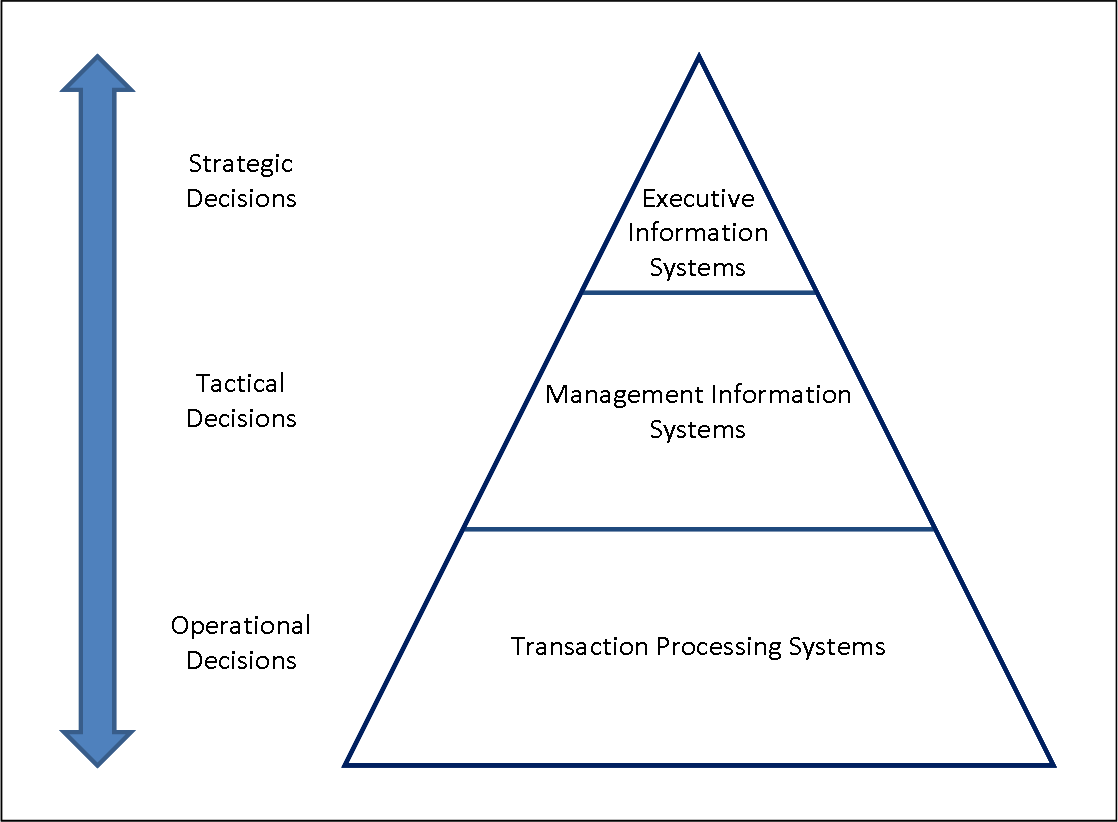
Source: chris-kimble.com.
That predictability and automation creates the foundation of the Transaction Processing System (TPS) - the lowest layer of information systems theory. This is where we're trying to reduce the influence of manual labor and produce the most accurate forms of data we can. It's the first place I start when coaching small business owners on managing their information as an asset: Their data is an invaluable byproduct of their operations.
Data is invaluable because of its influence on the Management Information System (MIS), the second tier of information system theory. This is the reporting and tactical analysis layer. It sits above the TPS and completely relies upon it. A great example of the MIS layer is a bank statement that summarizes the thousands of transactions that occurred in an account over the period of a month. The bank statement gives you a quick picture of deposits, withdrawals, and balances - without having to add and subtract the thousands of those little niggly transactions that took place over time - and allows you to make a decision.
Garbage In, Garbage Out - The GIGO Effect
How dependent is the MIS layer on the TPS layer? Watch the causality here:
- If I run a report on bad data ...
- I'm going to get bad or inaccurate information ...
- Which leads me to make incorrect decisions ...
- That eventually costs the firm in real waste, lost efficiency, or lost opportunity.
Garbage In, Garbage Out, right? Now, imagine doing that, over and over and over again. Automation's great, but if we don't treat information as an asset - that it's important to get the data right and accurate every single time - our business will chronically be making bad decisions and wasting money, except repetitively faster! Over and over again, we'll make the same dumb decisions based on the conclusions of errant data.
The Big Picture
Now, you are a business owner and likely don't have a lot of time to think about really abstract information theory stuff like TPS and MIS layers. I get it. That's my job. But here's the big take-away that I'd like to give you as a manager:
- How is your organization treating information as an asset? How much time and attention are you paying to make the TPS layer the most accurate it can be to get the greatest value out of the MIS layer?
- What is your organization doing to verify and challenge the results in the MIS layer? Not all data can be accurate; not all MIS layer conclusions should be relied upon. Do you challenge the assumption of TPS accuracy?
- Is the reporting found in the MIS layer the right report? For the right people? Is it providing the right information to the right people to help them do their job most effectively? Are there more reports, better reports, that could be used to solve an ongoing problem?
Now You're Thinking Strategically!
If you can start thinking about your IT spend in this way, you're just broaching the problem of strategically managing your information system. You're thinking proactively about the effect of automation, the data byproduct, and the expectations of efficiency. Kudos, dude: you're managing the problem. You're treating your information system as an asset.
Next time: core competencies and intellectual property.
R
Automated vs Manual Information Systems
Manual labor may not be adding any intrinsic value to a business process. In fact, manual labor may be slowing down the process, making it less accurate, less reliable, and costing your business lots of money over time. Here's where a more automated information system represents real opportunity for small business owners.
Manual Labor and the Impact upon an Information System

Last week, I got to writing about data and what an information system was. Today, I'm going to build upon those discussions and talk about automated versus manual information systems.
Okay, here's an exercise that's happy fun time. Let's get those hands dirty.
First, I want you to open Facebook and write down - by hand - all of the names of your friends on paper.
Next, I'd like you to re-enter those names into a spreadsheet because we're going to use that spreadsheet to conduct an email marketing campaign. Ready?
I know you're excited about doing this ... ready?!
Yah, not so thrilling, but let's examine this information system for a minute.
Duplicative, Non-Reproducible Efforts
There's a heavy labor component required in name acquisition, that is, you have to manually write down the names of your friends to a piece of paper. That activity is very time consuming for a human being. It takes a relatively long time to do that work in comparison to a computer which can do it in a matter of milliseconds.
In this process, there are two media at play:
- The information is first electronic;
- There's a manual transcription to paper that must take place;
- There's a manual transcription from paper to electronic media that must take place.
Within this one process, it's like we've purposefully created a vinyl record from an MP3, then played our vinyl record to listen to and record the sample again, and then, we copied the sound to another MP3.
Different media, same information transformed (three times!), no functional difference.
Further, once copied to electronic form the second time, the data is stale: we'd need to go back every day and do the same process by hand again.
Also, the same information has been duplicated in two places. From a security standpoint, this is more difficult to control. The paper copy is inherently without controls and cannot be audited.
Also, there's also risk of error in every transaction. With each recording of a name, the human being is prone to make mistakes, and the error rate will pass through to the email marketing campaign in one of two ways:
1. The data collected was gathered incorrectly;
2. The data transcribed into the next system was erroneous - like, a name was mistyped, for example.
And at the end of the day, the compounded errors, duplication of effort, redundant activity, and relatively slowness has cost the money significant dollars in labor cost.
Shouldn't IT Be Faster?
Okay, now, let's recall my speed, accuracy, and reliability argument from a few weeks ago. Relying on manual labor to conduct our sample business processes is inherently:
- Slow
- Error-prone
- Not reproducible
- Inconsistent
- Insecure
- Costly
As a business manager, you should be aware of how manual your business processes are. Take a good look around your shop. For a single critical business processes:
- For that one process, how dependent are you upon labor?
- For that one process, where is labor inserting itself where automation could do a better job?
- For that one process, how is the impact of manual speed, accuracy, and reliability affecting your competitiveness?
What's Left is Raw Opportunity
This gap - the difference between the current, manual information system and a potentially automated information system - represents an opportunity for you. It's the sweet spot strategy that I talked about last month (Reducing Expenses) that helps justify technology spend. It also represents a way for you to easily manage the technology problem on your hands: follow the labor.
- Where are people?
- What are they doing?
- What real value are they contributing?
- How is the impact of labor harming or helping the business model?
Next: information as an asset.
R
Turn Off Creepy Facebook Nearby Friends
Okay ... Facebook will, by default, share your location with nearby friends unless you turn off the feature.
What's nearby friends? Glad you asked. It is where Facebook is using the geolocation info from your phone to report where you are and if any of your pals are nearby.
Intrusive? Maybe! If you want to turn it off, here's what you do:
1. Sign into your Facebook app on your phone.
2. Go to More and select Nearby Friends.

3. Now, once there, go up to the gear on the right hand side:

4. And then turn off Nearby Friends:

Aw you're such a party pooper.
Anyway, if you ever wanted to turn it back on, you could. Just reverse the steps and flip the switch. You'd be the life of the party all over again.
Remember: it's not that Facebook's evil, they just think you want to be the most public person possible. You're able to control this capability on your own. That's a company thinking about privacy as an option :)
R