
The Z-Curve: the Timing of Technology Spending
Russell Mickler, technology consultant for small businesses in Vancouver WA, and Portland, OR, talks about how understanding the Z-Curve can help yield the highest rates of return on tech spend.
Does IT Spending Matter?

Nicholas Carr is one of the more controversial voices in my industry. Over over a decade, Mr. Carr has provided a contrarian view of IT spending and has even asked if IT spending really matters. His premise being that every technology eventually becomes ubiquitous and adopted by all, yielding businesses no competitive advantage. Crazy, eh? So his message begs us to ask, does tech spend really matter in the first place? If everyone eventually adopts technology at a ridiculously low cost an earns the same competitive differentiation from it's adoption, why are we interested in spending money on it ourselves?
Timing is Everything
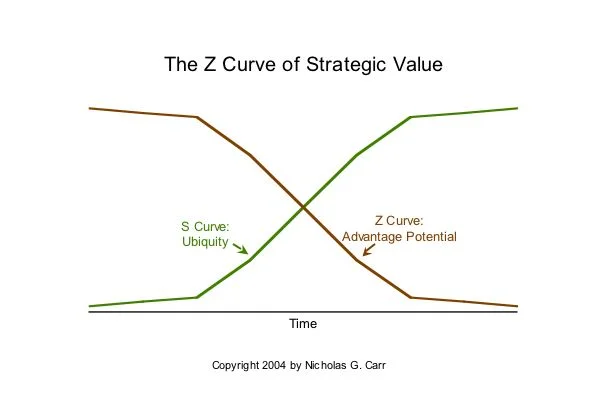
Core to Mr. Carr's observations is understanding where your industry is along the Z-Curve for adopting new technology.
This is his Z-Curve of Strategic Value. Yes, it looks more like an X-Curve but put that aside for a moment. You'll notice the S-Curve (ubiquity curve) shows that, over time, there is a relatively limited number of early adopters who embrace the technology, but during that early adopting period, they earn the highest potential for competitive advantage because nobody else has it yet. That's the Z-Curve you're seeing there, and the gap is very wide.

Now, over time, as more and more people adopt the technology, the competitive advantage gained from reducing expenses, containing expenses, or generating revenue slides off. You have a smaller range of competitive advantage because more people are applying the technology. Its cost and complexity is coming down, and more and more companies are beginning to install it. Over time, the technology becomes cheap and ubiquitous: everyone can afford it, everybody can have it, and it's now just a common aspect of doing business. What this is telling us that there's a timing involved for investing in technology that's earning first-mover and follower advantages.
What's the Difference and Why Do I Care?
That's a great question and it matters from a strategic standpoint:
- If we're looking to earn the highest rate of return on our technology spending, we would want to make investments early on in the adoption curve for proprietary advantages;
- If we're looking to earn a modest rate of return on our technology spending without taking on unnecessary risks associated with first-movers, then we'd be making investments mid-stream in the diminished advantages stage of the curve;
- And if we're looking to just stay in the game and be relevant - to have the same technology that everyone else does in our industry and what our consumer expects us to have - then we'd be investing in the weak advantage stage of the curve.
Small business can take advantage of the Z-Curve by innovating with technology: adopting new technologies that are in the proprietary advantages segment of the curve and gain the highest rate of return. They can also plot where the weakest advantage may be earned from the technology dollar should they continue to wait for adoption. This kind of awareness is all about managing IT problems instead of just reacting to them. It's what I help my clients do every day.
R
Generating Revenue
Russell Mickler, computer consultant in Vancouver, WA and Portland, OR, describes how small businesses can use technology spending to generate revenue and build residual income streams.

Over the last couple of weeks, I've been talking about the impact of automation for small business. I've been talking about being an owner and making rational decisions that help to either reduce expenses or contain expenses associated with the growth of a business. But today, I'm going to talk about a strategy that rarely applies to small business ... makin' money with technology investments.
Generating Revenue
What I'm referring to here is to use technology to create technology products. Technology products could be things like hardware or software. Example: your company makes cell phones or software apps that can be installed on cell phones. You make the products and sell them, making a little money off of each unit sold.
You can also make money off of intellectual property: patents, trademarks, trade secrets, or even books. Example: your company could have a patent on a critical business process that it licenses to other companies. You could have written a piece of software that gets licensed to other companies. Either way, you make money off of the licensing. Also, maybe you wrote a very successful book. Every time a book is sold, you're making a little bit of a royalty. That's money earned from intellectual property.
Why This Traditionally Doesn't Matter to Small Business ...
Usually, the generating revenue strategy isn't a good fit for small business because they're not making technology products, or, they don't own any intellectual property. It's a great idea it's usually not applicable. The small business is too busy doing small business things - things that matter to it and its customers - than focusing on making technology products.
... But Why It's So Cool!
The cool thing about this strategy is that it doesn't suffer from diminished returns as the previous two strategies.
On the one hand, when reducing expenses, you can never get expenses down to zero, and the closer you get to zero, the harder it is to earn any kind of return. Using the reducing expenses strategy, the earliest returns are the largest returns, and it's not a viable long-term approach to competitive advantage.
On the other hand, when containing expenses, you're dealing with the net present value of money. The money you earn in the future by investing in technology won't be worth as much as it is today. So relying on containing expenses also isn't the best strategy for long-term competitive advantage either.
Then there's making money! You can generate as much money as you want and there's no diminished return - with one exception: you'll pay more taxes, but still! Everyone likes making money. It's just kind of hard to do for small businesses because very often they're not a technology company in the first place.
Can Tech Pay for Itself?
The small business, though, isn't entirely out of this poker game. Let's say, for example, your company develops an app for a mobile device. There's nothing else like it out there. And in your commission agreement with the developer, you've retained the copyright IP (intellectual property) on that app.
With a slight modification to the app, not only could it fulfill your purposes, but it could be resold to other companies with similar problems, and your firm can earn money back from the IP investment. It's a residual revenue flow that helps to both offset the R&D (Research and Development) cost of the app, plus, it earns the company a little bit of pocket change over time.
Of course, the small business will eventually have to ask itself: are we a technology company? Are will going to continue to develop, distribute, and maintain software products for other companies in the future? That's where new ventures can be spun-off or sold to help pay for the risk taken when developing the IP.
Think about it: has your firm created unique pieces of software that it could market to others? Have you developed proprietary business processes that nobody else can easily emulate? Do you own patents, copyrights, or other forms of intellectual property that can be exercised to earn a residual income stream for your business?
Next time: what technology should be doing for you in the first place.
R
QR Codes Don't Matter
Russell Mickler, technology consultant in Vancouver, WA, explains why QR Codes don't matter to small business. Still, if you're going to use them, make sure they add value to each and every transaction.
... Or "Don't Invest in Geeky Stuff Nobody Uses" <rant>

Gosh I hate these things.
Well, okay, why?
Do you know what this is? Most people don't. It's a Quick Response (QR) Code.
They're super geeky, two-dimensional bar codes that were created back in 1994 that are devoid all branding. They found a purpose with smart phones once they were capable of browsing the Internet and taking pictures.
Now, if you download a special app that translates the bar code, it can convert it into a hyperlink that allows you to jump to a web page on the Internet, or, download programs.
As of 2013, less than 13% of all adult American cell phone users actually scanned a QR code. Uh, guys: that's like saying 87-percent of a market doesn't even know what to do with them, and they've been out now for nearly five years. Kids, that's a terrible adoption rate. Why would you ever use something that 87-percent of the population is clueless about?
Such low adoption hasn't prompted OEM's to include native software on their devices. Example: Apple and Samsung have yet to ship a native QR code reader, either, so you've got to know what software to use on your smart phone to make them work. They just don't magically work.
Strangely, a lot of marketers don't know what to do with them, either.
- They put them on a website. Why? So that some idiot can point their cell phone at a monitor, translate it, and then go somewhere on their cell phone? Duh.
- They put them on their business card, as if somebody is going to scan the QR code from the business card instead of typing in the website they already see on the card, or, scanned in already using Optical Character Recognition (OCR). Most people are going to type in the URL they see in an email address into a browser anyway. So why? Duh.
- They put them on their doors or storefront so that, when they're scanned, the user is brought to their webpage. Well, yes - we knew about your store, that's why we're here. We didn't have to leave home for that? Duh.
- They put them on a billboard that just redirects the user to a branded website. What extra value is that? So that some idiot can drive ... DRIVE!, whip out a phone, select an app, focus on the moving billboard ... CRASH! Duh.
- They put them on a box of purchased goods that the consumer takes home. Instead of a clever QR Code that could redirect the consumer (along with all of the purchase data) to a return process to be conducted online - I mean, real utility here - they're directed to the website of the company. Duh.

Furthermore, their use is redundant to things that people already understand, like smart phone apps. You can use apps easier than you can QR codes, so why would you ever want to point your phone's camera at one?
</rant> Okay, So Where Do QR Codes Make Sense
QR Codes make sense if you're doing something like this:
- Speaks to Youth. Marketing to kids, teenagers, and young adults, who're more apt to understand what to do with a QR Code - and have the software on their mobile device - than an adult. Their adoption rates are also higher.
- Extends Value. Example: imagine looking at a package of coffee on a retail shelf. Next to the retail pricing is a QR Code. The user scans it and they can be brought to a branded 30-second video that explains this specific coffee, where it was grown, who it was grown by, and what's the value in purchasing the coffee. Or in a museum where a 2-minute long video presentation can talk about a painting with a qualified art historian, and save your museum big bucks on having a couple of those people hanging around all day? Or how about on a menu? Scan the QR Code to see the full supply chain for that pork you're about to consume: from farmer, to processor, to distributor, to restaurant ... dates, times, quality, freshness. Hell, you'll know where your pig came from and eat in confidence. Notice that the QR Code extends information that adds value to the transaction.
- Captures Data. Instead of directing the user to a website, how about to a form to capture information about who clicked? What's your name, telephone number, purpose, and email, and can we call you back? Get a hold of you? The geo-tag of the scan (the GPS coordinates for where the scan was taken) as well as the technical information behind the device being used. The data can then be added to an active list or CRM package to facilitate customer contact, data analysis, or data mining.
- Initiates a Purchase Online. See something. Snap the QR Code. Purchase it directly.
- Provides a Utility. Like I was saying earlier, if a QR Code was printed on a receipt or a shipping container, why can't the QR Code leap the user into an authorized return process for the specific receipt that could be conducted from the cell phone? Why can't I just scan a QR Code on an envelope when I receive a piece of mail to confirm my receipt with a second factor of authentication, like, a password or a PIN number? Why can't I scan your company's QR Code to download an app?
Where To Go From Here
So, okay. Maybe I've convinced you that geeky stupid QR Codes isn't something you need to invest in. Cool. All the better.
But if you're still hip on using them, think about the stuff I mentioned earlier. How does every scan provide value and differentiation between you and your competitors? How do they facilitate engagement or foster self-service? And the next time you want to have a QR Code and just point it at your website, please ... think again. It's a pointless exercise if I can just click on a hyperlink and get there faster and easier. Don't make the obvious more difficult.
Okay. I'm done. Thanks for reading.
R