
The Z-Curve: the Timing of Technology Spending
Russell Mickler, technology consultant for small businesses in Vancouver WA, and Portland, OR, talks about how understanding the Z-Curve can help yield the highest rates of return on tech spend.
Does IT Spending Matter?

Nicholas Carr is one of the more controversial voices in my industry. Over over a decade, Mr. Carr has provided a contrarian view of IT spending and has even asked if IT spending really matters. His premise being that every technology eventually becomes ubiquitous and adopted by all, yielding businesses no competitive advantage. Crazy, eh? So his message begs us to ask, does tech spend really matter in the first place? If everyone eventually adopts technology at a ridiculously low cost an earns the same competitive differentiation from it's adoption, why are we interested in spending money on it ourselves?
Timing is Everything
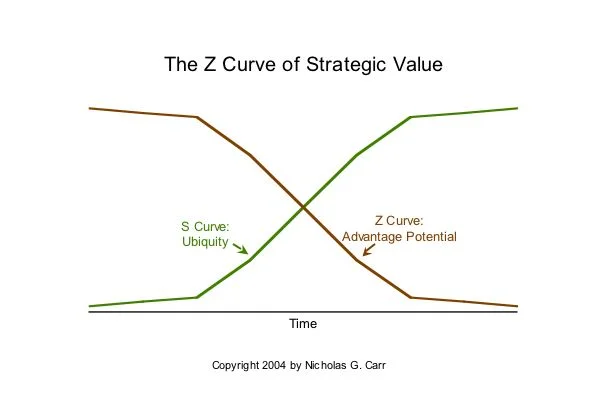
Core to Mr. Carr's observations is understanding where your industry is along the Z-Curve for adopting new technology.
This is his Z-Curve of Strategic Value. Yes, it looks more like an X-Curve but put that aside for a moment. You'll notice the S-Curve (ubiquity curve) shows that, over time, there is a relatively limited number of early adopters who embrace the technology, but during that early adopting period, they earn the highest potential for competitive advantage because nobody else has it yet. That's the Z-Curve you're seeing there, and the gap is very wide.

Now, over time, as more and more people adopt the technology, the competitive advantage gained from reducing expenses, containing expenses, or generating revenue slides off. You have a smaller range of competitive advantage because more people are applying the technology. Its cost and complexity is coming down, and more and more companies are beginning to install it. Over time, the technology becomes cheap and ubiquitous: everyone can afford it, everybody can have it, and it's now just a common aspect of doing business. What this is telling us that there's a timing involved for investing in technology that's earning first-mover and follower advantages.
What's the Difference and Why Do I Care?
That's a great question and it matters from a strategic standpoint:
- If we're looking to earn the highest rate of return on our technology spending, we would want to make investments early on in the adoption curve for proprietary advantages;
- If we're looking to earn a modest rate of return on our technology spending without taking on unnecessary risks associated with first-movers, then we'd be making investments mid-stream in the diminished advantages stage of the curve;
- And if we're looking to just stay in the game and be relevant - to have the same technology that everyone else does in our industry and what our consumer expects us to have - then we'd be investing in the weak advantage stage of the curve.
Small business can take advantage of the Z-Curve by innovating with technology: adopting new technologies that are in the proprietary advantages segment of the curve and gain the highest rate of return. They can also plot where the weakest advantage may be earned from the technology dollar should they continue to wait for adoption. This kind of awareness is all about managing IT problems instead of just reacting to them. It's what I help my clients do every day.
R
Reduce Your Expenses
One of the most common and most basic strategy for applying technology investments is by reducing expenses. Here's what that means, and why it's not a perfect solution for long-term returns. Russell Mickler, computer consultant in Portland, Oregon and Vancouver WA, walks you through the problem.
IT Strategy: Reducing Expenses
Okay, so a couple of days ago, I wrote about the effects automation should have on a business. More investment in technology yielded greater automation, reduced or diminished the impact of labor, increased productivity, systemized the business to transform it from a job and into an asset, and increased profitability.
And in that discussion, I promised you that I'd discuss three strategies that business can use to apply their technology investments. One of the three strategies, Reducing Expenses, is the easiest to understand and the most obvious.

Greater investments in technology automates the business, improves productivity and efficiency, and reduces operating expenses. Tech investments allow you to do more with less. That, in turn, improves profitability.
It's a Great, Basic Strategy ...
Reducing Expenses is the easiest, most basic strategy for applying IT expenditures. It's the first place we look to when trying to measure a Return on Investment (ROI) associated with technology investments.
In calculating an ROI for this kind of strategy, you'd approach it in four steps:
- Measure the cost of doing nothing - add up how much it terms of labor and materials to do the existing business process.
- Measure the time involved for doing the existing business process.
- Apply the technology investment.
- Now compare the new cost of labor and materials, and, the time it takes to get the business process done.
- Divide the dollar amount saved against the amount spent on the technology investment.
Example:
Let's say that a business process took $6,500 and 16 hours in labor and materials and time. In investigating the business process, it's determined that $2,000 in technology spend can help the employees work smarter. After deployment, new measurements are taken. The new process is $3,900 and takes just 11 hours to perform. That's a $2,600 savings from $2,000 worth of investment, or a 130-percent ROI. Plus - and a big bonus here - we're saving five hours. Gosh, more time! What's that worth?
... But You Can't Reduce to Zero
Pretty cool, huh? Well, it's cool for the first couple of go-arounds anyway. Eventually, we'll run up against the limits of what current technology can offer us. We can only reduce expenses so far. We can't make the business process operate at $0.00 dollars and at zero expenses taking zero time. That's impossible!
It's the Law of Diminishing Returns at play - over time, we can only reduce expenses just a little bit more, just a little closer to zero (but not actually reaching zero), until there's a huge shift or change in technology - which means every incremental investment returns less and less time and money.
That makes Reducing Expenses a common, basic strategy but an insufficient play in the long-term. It has to be paired with other techniques to obtain even higher returns from technology spending. Next time, we'll talk about another approach: Containing Expenses.
R
IT Authority Policy
Administrative Controls are policies and procedures that govern your IT environment. The Sample IT Authority Policy sets up the chain of authority for who can create and manage Admin Controls in your company.
I often write draft policy documents for my clients. I thought I'd go through a refresh those documents, and begin a blogging series that highlights the importance of Administrative Controls.
Administrative Controls are a "best practice" approach to managing information technology assets. They are the policies, procedures, and work instructions that convey management's expectations governing the use of those assets. These controls demonstrate management's interest and engagement in the process of managing information technology.
The risk concerning Administrative Controls is found in their absence, especially in areas of technical compliance. If management never bothered to create a policy governing their IT assets, they never bothered to create and communicate expectations to their employees, shareholders, or consumers, and therefore it could be construed they never intended to manage their IT environment in the first place. That lack of attention could be thought of as negligence, like, "why didn't management take reasonable, 'best practice' precautions in managing their stuff, anyway?"
In legal terms, management loses a "due care" argument: they never understood nor accepted the risks for managing their IT environment and never took "due care" obligations seriously. That becomes a hole in their defense of a negligence claim.
The first policy I help my clients introduce is the IT Authority Policy. The IT Authority Policy identifies the executive responsible for implementing the suite of IT policies and procedures. This is the party responsible and accountable for IT policy implementation. This document serves as authorization from the chief executive or board of directors, delegating authority for managing the IT problem, and becomes the basis from which all other IT Policies are drafted.
This is a reasonable Authority Policy that can be modified to suit your needs; it is intended for use with a small to mid-range business. Have fun with it. Meanwhile, stay tuned for more policies and procedures that'll be introduced through my blog and available eventually from my website.
R