
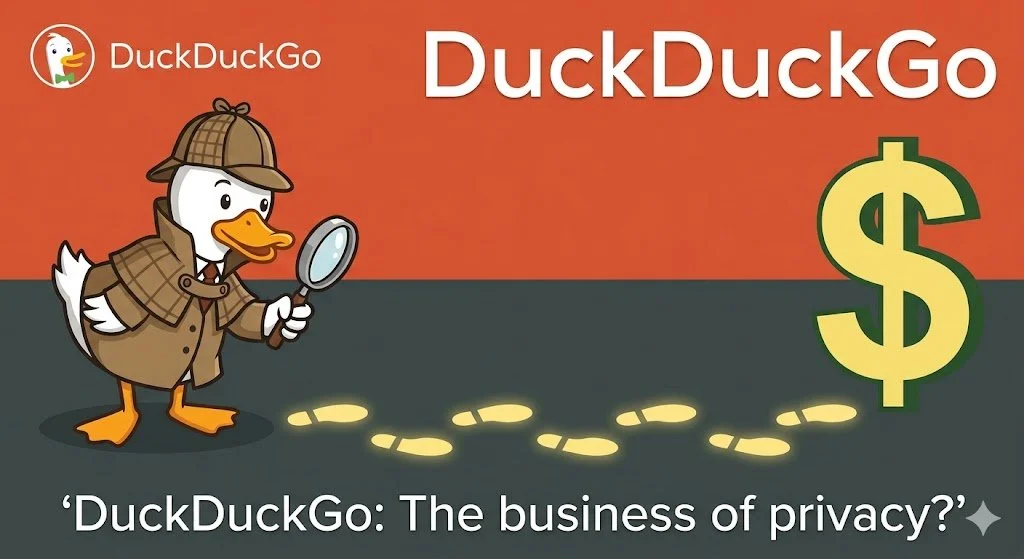
Is Duck-Duck-Go All It’s Quacked Up to Be?
Is DuckDuckGo truly the privacy savior it claims to be? In this post, we peel back the "anti-Google" mystique to explore how the platform actually makes money. From the nuances of contextual advertising to the complexities of their syndication agreement with Microsoft, we analyze the "Microsoft Asterisk" and the risks of privacy theater. Learn why your temporary intent is their primary product.
For years, DuckDuckGo has been the darling of privacy-conscious clients, lured by an "anti-Google" mystique. But in 2026, as digital literacy evolves, I feel it’s worth asking: DuckDuckGo is a business. They must make money. And if you aren’t paying for the product, what is being sold?
The Business of Context
DuckDuckGo isn’t a charity; it’s a profitable enterprise. Unlike Google, which sells behavioral ads (based on who you are and where you’ve been), DuckDuckGo primarily sells contextual ads.
When you search for "mountain bikes," they show you an ad for a bike shop. They don't need to know your age or medical history to do this — they just need to know what you typed into the search bar right now. This is their primary revenue stream, often facilitated through a long-standing syndication agreement with Microsoft.
The Microsoft "Asterisk"
I feel the biggest risk for users is "privacy theater." In 2022, it was revealed that while DuckDuckGo's browser blocked Google and Facebook trackers, it purposefully allowed Microsoft trackers due to their search contract. So DuckDuckGo isn’t tracking you, but Microsoft is. While they have since increased transparency and tightened these rules, it serves as a reminder: contractual obligations can trump privacy promises.
What are the Risks?
The Affiliate Loop: DuckDuckGo earns commissions through affiliate links (like Amazon or eBay). While anonymous, this still incentivizes the platform to direct your journey toward specific retail partners.
False Sense of Security: DuckDuckGo protects your search, not your connection. It is not a VPN, and it doesn't stop websites from "fingerprinting" your device once you leave the search results page. This means websites beyond DuckDuckGo profile you just as they normally would if you were using Google to find them.
Contextual vs. Behavioral: Why the Difference Matters
To understand DuckDuckGo’s model, you have to look at the "how" behind the ads.
Behavioral advertising (BA) are the bread and butter of giants like Google and Meta, built on a foundation of long-term surveillance. BA methodology creates a "shadow profile" of you by tracking your location, purchase history, and even the contents of your emails. When you see an ad for hiking boots on a news site, it’s not because the article is about hiking; it’s because the algorithm knows you were looking at boots three days ago. The risk here is data persistence: your past interests follow you forever.
Contextual advertising (CA), which DuckDuckGo utilizes, operates in the "now." It relies entirely on the content of the page you are currently viewing or the specific keyword you just typed. If you search for "best organic coffee," the engine shows you coffee ads. Once you close that tab, the relationship ends.
Profiling
But wait a sec. How can DuckDuckGo not profile users in some way? After all, the "If you aren’t paying for the product, you are the product" rule has rarely been proven wrong. However, there is a technical and legal distinction between what Google does and what DuckDuckGo claims to do. Here is the breakdown of why DuckDuckGo argues they don’t profile you.
1. No Personal Identifiers
Google’s business model depends on identity. They want to know your name, age, and location so they can link your search for "engagement rings" to your YouTube watch history and your Google Maps data.
DuckDuckGo, by contrast, claims to not store IP addresses or unique identifiers alongside your searches. In theory, this means they can’t "profile" you because they don’t have a "you" to attach the data to. Every time you search, you are essentially a stranger to them.
2. The Partner Problem (Microsoft)
This is where all bets are off While DuckDuckGo doesn’t profile you, they have historically had agreements with Microsoft to provide search results and ads.
The Risk: In the past, DuckDuckGo's browser was found to allow Microsoft trackers while blocking others.
The Defense: They have since tightened this, and audits as recent as early 2026 suggest they do not retain user-identifiable data. However, when you click a search ad, you are effectively entering Microsoft’s ecosystem, and at that point, DuckDuckGo can no longer protect you from Microsoft’s own data practices.
The Reality: DuckDuckGo’s strategic relationship with Microsoft voids their assertion of being a completely independent crawler. They use a variety of sources, but their primary partner for search results and advertisements is Microsoft (Bing).
The Pro-DDG View: Okay, so they’re are a privacy-focused "skin" that filters out the tracking junk Microsoft usually attaches to search results.
The Skeptic's View: But what they really are is a specialized sales channel for Microsoft’s ad inventory, targeting users that Microsoft couldn't otherwise reach.
3. The Lack of "Memory"
The biggest difference is that DuckDuckGo doesn't provide personalized search results. If you and I both search for "Python," Google might show you the snake (because you like zoos) and show me the programming language (because I'm a developer and IT guy). On DuckDuckGo, we both see the same results.
Crucial Distinction: DuckDuckGo isn’t trying to build a "virtual identity" of you because their search engine isn't designed to use one. Their ads are sold based on the keyword, not the person.
The trade-off is efficiency vs. privacy. Behavioral ads are often more "relevant" because they know your deepest habits, but they require a massive, centralized database of your life to function.
Contextual ads are less precise but far safer; they monetize your temporary intent rather than your permanent identity.
For a business like DuckDuckGo, this is the middle ground that allows them to pay the bills without needing to own your digital soul.
The Bottom Line
DuckDuckGo is a business selling a cleaner search experience, but they are still a middleman in a multi-billion dollar advertising ecosystem. They aren't selling "you," but they are selling your intent — to Microsoft — and that still has a price.
R

Are You Prepared for the Silver Tsunami?
The "Silver Tsunami" is more than a demographic shift; it’s a critical turning point for small business owners. With nearly half of entrepreneurs nearing retirement, the race is on to secure your legacy. Learn why succession planning, modernizing your IT infrastructure, and prioritizing "digital survivorship" are essential for a successful transition.
It’s possible you haven't heard the term Silver Tsunami yet, and if you haven’t, it’s time to pay attention.
We are currently witnessing a massive demographic shift as Baby Boomers reach retirement age. According to recent reports, nearly half of all small business owners are over the age of 55. As these entrepreneurs prepare to exit the workforce, the landscape of our local economy in Vancouver and across the country is set for a dramatic transformation.
Why This Matters
For current owners, this "tsunami" represents a looming challenge related to transition, wealth transfer, and survivorship. For prospective buyers or younger entrepreneurs, it’s a period of unprecedented opportunity.
However, without a clear plan, this shift could lead to a "succession gap" that threatens the stability of many long-standing community staples.
Three Ways to Prepare
Prioritize Succession Planning: If you are an owner looking toward retirement, don't wait until you're ready to walk out the door. Whether selling to a competitor, an employee, or a family member, transitioning your business to someone else takes years to execute effectively.
Modernize Your Infrastructure: To make your business attractive to the next owner, your technology environment must be current, documented, and stable. Moving to cloud solutions and ensuring your data is secure makes your business a "turn-key" asset rather than a project.
Invest in Your Talent: The labor market will feel the squeeze as experienced leaders retire. Cross-training your younger staff now ensures that institutional knowledge doesn't walk out the door when your senior employees do.
Digital Survivorship
Part of your job as a business owner is to prioritize digital survivorship.
In an era where a company's value is increasingly tied to its data, software, and online presence, failing to document your IT infrastructure can be a "deal-killer" for potential buyers. A comprehensive IT plan ensures that critical login credentials, vendor relationships, and proprietary workflows don't reside solely in the mind of the retiring owner.
By systematizing your digital environment now, you aren't just organizing files and updating your procedures. You’re creating a transferable, resilient asset that allows the next generation of leadership to hit the ground running without a catastrophic loss of institutional knowledge.
What, you worry? The Silver Tsunami doesn't have to be a disaster. With the right leadership and a proactive approach to technology and planning, you can ensure your business remains a pillar of the community for decades to come.
Need help? I’m just a click away.
R

How Small Businesses Will Survive COVID-19
Small businesses have the ability to create experiences that larger companies can’t replicate. It’s those experiences, those expressions of genuine human kindness, that will differentiate your value and keep your customers coming back … even in the most difficult of times.
It’s undeniable that small businesses face unprecedented challenges in the age of COVID. These are difficult times for everybody and - arguably - the difficulties are just beginning.
Still, regardless if it were a hurricane, a major earthquake, a financial crisis, or a pandemic, it’s my view that small businesses have a competitive advantage during tough times that much larger firms do not.
I’m not referring to their smaller size, their nimbleness, or their innate ability to quickly shed fixed costs. Rather, small businesses have a face. Your face.
Your small business has the ability to project sincerity and compassion in a way that larger firms cannot. Your competitive advantage as a small businesses in hard times is kindness.
People. And I’m talking about customers, vendors, employees, and service providers. Even in an extremely disconnected, automated, and disintermediated economy such as ours, in a practical sense, businesses cannot operate without people buying, selling, delivering, shopping, providing, shoveling, mopping, cleaning, browsing, clicking, or calling. People drive every aspect of our business.
In times like these, savvy small business owners would do well to recognize their unique ability to connect with people as an advantage in every transaction. That they have the opportunity to project sincerity and compassion in ways a bigger company cannot.
And that could come in so many forms. More smiles. More listening. Arriving on time and respecting somebody’s time. By not taking a single opportunity for granted. Through offering a simple sticky note to affirm somebody’s great work. By being enthusiastic. By focusing on the good around us rather than chronically dwelling on the bad. And sure, more tangible things like more bonuses, more breaks, more time off, more leeway, more investment in PPE, or more flexibility - understanding that schedules aren’t as reliable as they had been - but the real advantage being exercised here is just human kindness.
Think about the last COVID-19 response you received from your big bank. It was delivered at four in the morning. It said (with a charming, smiling clip-art graphic), “We’re here for you day and night!”, and it offered a link to their website so they could continue to take your money for credit card or loan payments. They’re a huge corporation! They can’t honestly identify with you insomuch as you can relate to them. Inasmuch, your big bank can’t possibly appear sincere, or empathetic, or truly engaged.
Now picture somebody like me, a computer consultant, coming in to your place of work. I arrive on time. I’m dressed professionally. Sure, I smile under my mask these days, but people can see that in my eyes. I engage in friendly conversation, empathize with your current situation, and I quickly resolve the technical matter. I explain what went wrong in easy terms you can understand. Further, I explain strategies for how we might avoid it in the future. I leave you my business card so you can contact me at any time. And I thank you once again for your continued business.
Now, that’s all just something the big tech support firms, the big box stores, and the nameless phone companies can’t do. They’ve focused so much of their business on scale, volume, you’re a number so be a number, take a ticket, leave a message, press a button, wait a day, but please keep having problems, and pay our retainer, keep feeding us money to support our waterfront offices … sigh.
Well, which of those experiences are you going to remember?
Kindness is competitive.
I feel that demonstrating genuine, compassion to others is the value-add that the big guys simply can’t compete with. In good times or in bad. It could be the advantage that inspires your team to keep coming back to work. It could be the gentle reminder of a pleasant experience that brings a customer back. It could be the portrayal of confident professional enthusiasm that’ll prioritize a check for you in the mail this week.
It could be that kindness … is the one thing that makes you, your products, your services, more memorable, and keeps people calling you over somebody else.